Jan 21, 2026
A Day of Truth & Freedom: Imagining the World as it Could Be
A Personal Reflection by the Rev. Dan Ruth
For the Lord your God is God of gods and Lord of lords, the great God, mighty and awesome, who is not partial and takes no bribe, who executes justice for the orphan and the widow, and who loves the strangers, providing them food and clothing. You shall also love the stranger, for you were strangers in the land of Egypt.
-Deuteronomy 10:17-19
Living in Minneapolis, I’ve been seeing ICE raids happening in my neighborhood. Tinted-glass vehicles appear, masked agents emerge, and families live in terror that a trip to the grocery store or a drive to work might end in separation.
For those of us who are U.S. citizens, who don't fear the knock on the door, the question is different but no less urgent: What does faithful witness look like in this moment?
LPGM's Vision: We envision a world where relationships transform boundaries, and where all people have the resources and opportunities they need to thrive.
LPGM's Mission: We provide access to quality education to people at the margins—especially women and girls. We work with global partners to listen, respond, and bear witness to local needs and priorities.
Empire's Narrative vs. God's Reality
The theologian Walter Brueggemann writes about how empire operates primarily through controlling our imagination—our sense of what's possible, what's necessary, what's real. Empire tells a story saturated with anxiety and scarcity: They're taking our jobs. They're overwhelming our systems. They're criminals. We must protect ourselves. This narrative makes militarized enforcement seem not just reasonable but inevitable, the only realistic option.
But here's what the evidence actually shows: Immigrants, including undocumented immigrants, commit crimes at significantly lower rates than native-born Americans. Study after study confirms this. In Texas, for instance, undocumented immigrants were arrested for violent crimes at rates 50% lower than native-born citizens. Nationwide data shows similar patterns. The "criminal immigrant" is a manufactured threat, a story empire tells to justify its violence.
The real story is different. The people being targeted in Minnesota are our neighbors—literally. They're the folks who live down the hall, who send their kids to school with ours, who work alongside us. They're members of our congregations, volunteers at community centers, small business owners. They contribute billions in taxes annually, including to systems like Social Security, even though they often cannot access the benefits. They are woven into the fabric of our communities.
The Lutheran Calling: Living for the Neighbor
As a Lutheran, I confess that I am freed in Christ to serve the neighbor. Not the neighbor who looks like me, not the neighbor with the right documentation, not the neighbor who makes me comfortable—simply the neighbor. The one who is near. The one in need.
Jesus makes this uncomfortably concrete in the parable of the Good Samaritan. The lawyer asks, "Who is my neighbor?" trying to draw boundaries, to establish limits on obligation. Jesus responds with a story about a despised outsider—the Samaritan, the undocumented of his day—who shows mercy when the religious insiders pass by. Then Jesus asks: "Who proved to be a neighbor?" The answer reframes everything: the question isn't "Who qualifies as my neighbor?" but rather "How will I be a neighbor?"
That's at the center of LPGM's mission and vision.
Right now, in Minnesota, our neighbors are terrified. Children are asking their parents, "Will you be here when I get home from school?" Families are avoiding schools and churches—yes, churches—for fear of deportation. People are sheltering in place. Even a trip to the store feels too risky. Once vibrant cultural spaces and corridors are empty and silent. Immigrant-owned businesses are closing or are keeping their doors locked for safety.
Recovering Prophetic Imagination
We must name what's happening. These aren't simply "immigration enforcement operations." They're raids that terrorize entire communities. They separate parents from children—a practice we rightly condemned at the border, and which is no less traumatic when it happens in St. Paul or Worthington. They target people whose "crime" is often nothing more than seeking safety and opportunity, crossing an arbitrary line that most of us crossed by accident of birth.
We must name the scarcity thinking that drives this: the lie that there isn't enough, that we must hoard and protect and exclude. Minnesota, like the nation, has abundant resources. The question isn't capacity—it's will. It's whether we'll organize our common life around fear or around the abundance God provides.
But naming alone isn't enough. We must also practice and proclaim alternatives. What does this look like?
It means sanctuary—not just as symbolic gestures but as concrete protection. Churches, homes, and communities becoming places of safety.
It means accompaniment—showing up at ICE check-ins, creating networks to support families facing separation, ensuring no one faces the machinery of deportation alone.
It means advocacy—calling our representatives, demanding humane policies, supporting organizations doing legal defense and community support. It means using our privilege to shield those who have none.
It means relationship—actually knowing our immigrant neighbors, hearing their stories, allowing our hearts to be changed by their witness. Not helping from a distance but walking alongside.
The Resurrection Politics of Hope
Here's the scandalous claim at the heart of Christian faith: empire never has the last word. Death,separation, and violence are real—brutally, painfully real. But they're not final. The resurrection is God's definitive "no" to empire's logic of domination and death.
This doesn't make the fear less real for families hiding in Minnesota today. But it does mean we act from hope rather than despair, from abundance rather than scarcity. We refuse to accept empire's claim that this is simply how things must be.
Lutherans confess that we are simultaneously saint and sinner—simul justus et peccator. We don't act because we're pure or because we have it all figured out. We act because Christ has freed us to fail, to try, to show up imperfectly but faithfully for our neighbors.
We act knowing we'll get it wrong sometimes, knowing we're complicit in systems we can't fully escape, but acting anyway because love demands it.
What Now?
So what does faithful witness look like in Minnesota right now?
Learn your neighbors' names. Not to report, not to save, but to know and be known.
Support sanctuary efforts in whatever way you can—offering space, resources, presence.
Contact your representatives. Demand they oppose these raids and advocate for humane immigration policy.
Support organizations doing legal defense and community support—like the Immigrant Law Center of Minnesota, or ISAIAH.
Show up. At vigils, at court hearings, at ICE check-ins. Make your body present.
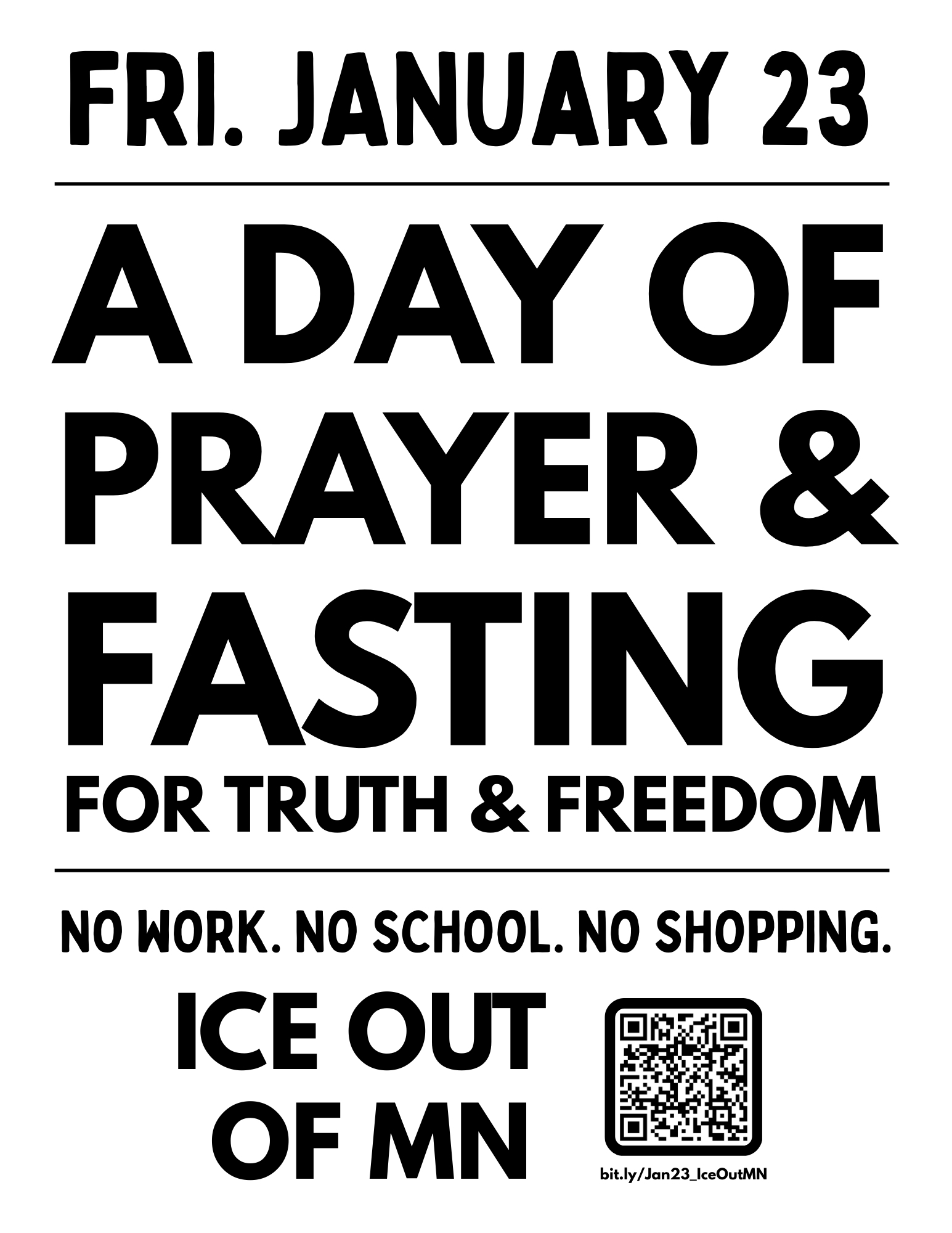
Join me in A Day of Prayer & Fasting for Truth & Freedom on Friday, January 23, 2026.
Tell different stories. Counter the narrative of fear with testimonies of actual immigrant neighbors and their contributions to our communities.
Open your church to conversations about how congregations can be communities of sanctuary and solidarity.
The empire wants us to accept its story: that this is necessary, that this is just how things are, that there's nothing to be done. The prophetic imagination insists otherwise. It insists that another world is possible—one where the stranger is welcomed, where there's enough for everyone, where love casts out fear.
Our neighbors are afraid. The question is: Will we pass by on the other side, or will we prove to be neighbors?
The raids in Minnesota aren't just a policy issue. They're a test of our imagination, our faith, our willingness to embody the resurrection politics of Jesus in a world still gripped by empire's death-dealing logic. May we have the courage to fail faithfully, to act imperfectly, to love concretely.
Because that's what neighbors do.

The Rev. Daniel Ruth is the executive director of Lutheran Partners in Global Ministry (LPGM), and an ordained minister in the Evangelical Lutheran Church in America (ELCA). Dan is passionate about helping people see where God is at work in the world. With experience in international development and nonprofit communications, Dan focuses on helping create the most meaningful outcomes or impact. He joined LPGM in 2017.